
The aim of the session was to take stock of Payments for Environmental Services (PES), a mechanism increasingly presented as a central lever for reconciling the fight against deforestation, food security, and the development of rural communities in the Congo Basin.
This second-largest tropical forest massif in the world spans six countries (Cameroon, Central African Republic, Republic of Congo, Democratic Republic of Congo, Gabon, and Equatorial Guinea), with dense, humid forests still covering nearly 200 million hectares out of a total area of around 3.7 million km².
The webinar first set out the terms of the debate: Central Africa reportedly holds one of the strongest PES potentials in the world, with more than 270 million hectares suitable for such activities without further deforestation.
According to CAFI modelling cited in the presentation, a full rollout of PES across the region could sequester up to 4.8 gigatonnes of CO2e per year — roughly seven times the Congo Basin's total greenhouse gas emissions recorded in 2022. According to the speaker, this potential aligns closely with the momentum of the Belém Action Call, which invites tropical forest regions to combine forest protection with equitable economic opportunities.
The presentation then detailed the theoretical foundations of PES: voluntary transactions between one or more buyers and a provider of an environmental service, where payment is only triggered once the virtuous practice has actually been verified (the conditionality principle), and which must generate a benefit beyond what regulation would already require (additionality).
The environmental services provided by forests were grouped into four broad categories: regulating functions (climate, water cycle, erosion control, biodiversity, carbon storage), productive functions (timber, energy, food and medicinal resources), physical support functions (habitat, agricultural land, conserved sites), and informational functions (aesthetic, cultural, and scientific value).
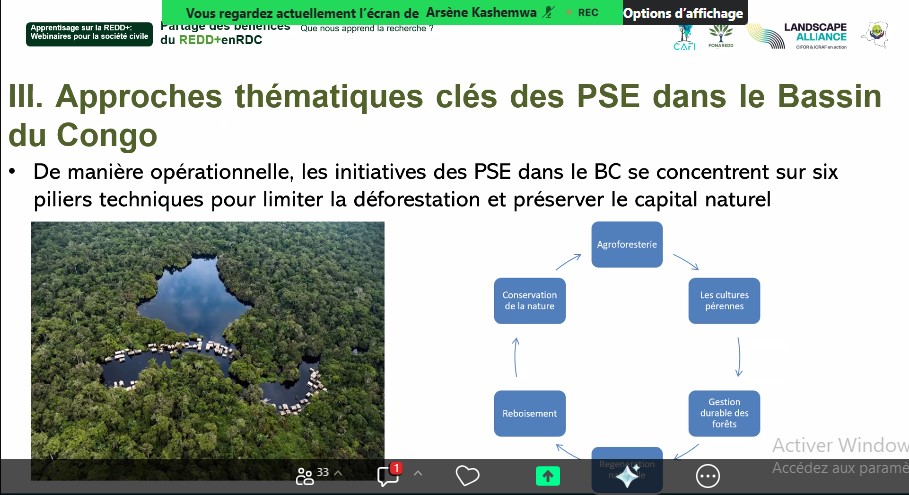
Operationally, PES initiatives in the Congo Basin are built around six technical pillars: agroforestry, perennial crops, sustainable forest management, natural regeneration, reforestation, and nature conservation.
To move beyond a purely theoretical stage, several Central African countries have adopted dedicated technological tools: a geographic planning and targeting software ("Ground Impact PES") designed to assess the projected impact of investments, along with a management application centralizing application intake, mapping oversight, and automated payment calculations. Oversight relies on field agents and satellite remote sensing, tasked with validating environmental compliance before any financial transfer takes place.
According to the presentation, PES governance operates on two complementary levels: a regional scale, driven by international partnerships (COMIFAC, PFBC, CAFI, the Congo Basin Blue Fund), and a national scale, grounded in each country's domestic law and in the principle of subsidiarity toward Indigenous peoples and local communities, in order to avoid "poverty traps."
The speaker also distinguished two concrete scales of application: the individual/household scale, which targets smallholder farmers and small landowners, offering the advantage of directly securing household income but at a high cost of technical monitoring; and the community/territorial scale, which targets community concessions, villages, and Indigenous peoples, raising significant challenges around equitable benefit-sharing and managing local governance conflicts.
The webinar closed with a set of operational recommendations aimed at civil society organizations:
- Take on the role of Local Implementing Agency (LIA), using standard partnership contracts aligned with proven models of due diligence, financial accountability, and monitoring and evaluation;
- Identify and support Local Consultation Frameworks (CFCLs) and existing PES initiatives;
- Promote community development and income-generating activities (IGAs);
- Strengthen sustainable agricultural and forestry value chains;
- Oversee the establishment and facilitation of local consultation platforms;
- Raise awareness and advocate for stakeholder engagement in land-use planning, natural resource management planning, and land governance processes.